2024 United States presidential election
Presidential elections were held in the United States on November 5, 2024. The Democratic Party's ticket—Kamala Harris, the incumbent U.S. vice president, and Tim Walz, the incumbent governor of Minnesota—defeated the Republican Party's ticket—Donald Trump, who served as the 45th president of the United States from 2017 to 2021, and JD Vance, a U.S. senator from Ohio.
.svg) | |||||||||||||||||||||||||||||
| |||||||||||||||||||||||||||||
538 members of the Electoral College 270 electoral votes needed to win | |||||||||||||||||||||||||||||
|---|---|---|---|---|---|---|---|---|---|---|---|---|---|---|---|---|---|---|---|---|---|---|---|---|---|---|---|---|---|
| Opinion polls | |||||||||||||||||||||||||||||
| Turnout | 62.7% ( 4.2 pp) 4.2 pp) | ||||||||||||||||||||||||||||
| |||||||||||||||||||||||||||||
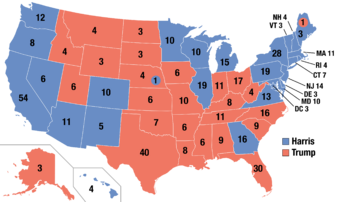 Presidential election results map. Red denotes U.S. states won by Trump/Vance and blue denotes those won by Harris/Walz. Numbers indicate electoral votes cast by each state and the District of Columbia. | |||||||||||||||||||||||||||||
| |||||||||||||||||||||||||||||
.jpg)
.jpg)
The incumbent president, Democrat Joe Biden, initially ran for re-election as the party's presumptive nominee, facing little opposition and easily defeating Representative Dean Phillips of Minnesota during the Democratic primaries; however, what was broadly considered a poor debate performance in June 2024 intensified concerns about his age and health, and led to calls within his party for him to leave the race. After initially declining to do so, Biden withdrew on July 21, becoming the first eligible incumbent president to withdraw since Lyndon B. Johnson in 1968. Biden endorsed Harris, who was voted the party's nominee by the delegates on August 5 and became the first nominee who did not participate in the primaries since Hubert Humphrey, also in 1968. Harris selected Walz as her running mate.
Trump, who lost the 2020 presidential election to Biden, ran for reelection to a nonconsecutive second term. He was shot in the ear in an assassination attempt on July 13, 2024. Trump was nominated as the Republican Party's presidential candidate during the 2024 Republican National Convention alongside his running mate, Vance. The Trump campaign ticket supported mass deportation of undocumented immigrants; an isolationist "America First" foreign policy agenda with support of Israel in the Gaza war and skepticism of Ukraine in its war with Russia; anti-transgender policies; and tariffs. The campaign also made false and misleading statements, including claims of electoral fraud in 2020. Trump's political movement was seen by some historians and some former Trump administrators as authoritarian.
Harris won the Electoral College with 303 electoral votes to Trump's 235. She carried every state that Biden won in 2020, including the critical battlegrounds of Michigan, Pennsylvania, Wisconsin, Arizona, Georgia, and Nevada. She also won Nebraska's 2nd congressional district, which had been a key target for both campaigns. Harris lost North Carolina and Florida by narrow margins. She became the first woman and first Asian American to be elected president of the United States. Harris won the national popular vote with 51.2%, defeating Trump by a margin of approximately 5.5 million votes. Analysts credited Harris's victory to high Democratic turnout, broad suburban support, and improved margins among women and young voters.
Background


In 2020, incumbent Republican President Donald Trump was defeated by Democratic challenger Joe Biden. Democratic U.S. Senator Kamala Harris of California was elected vice president as Biden’s running mate.
Trump was the first president in U.S. history to be impeached twice, and the first to seek re-election following impeachment. As he was acquitted by the Senate in both cases, he remained eligible to run in 2024.
Election interference
In the run-up to the 2024 election, several state officials and courts attempted to disqualify Trump from the ballot under Section 3 of the Fourteenth Amendment to the United States Constitution, citing his role in the January 6 Capitol attack. These included the Colorado Supreme Court, a Circuit Court in Illinois, and the Secretary of State of Maine.
On March 4, 2024, the U.S. Supreme Court ruled unanimously in Trump v. Anderson that states lacked the authority to enforce Section 3 for federal candidates without congressional legislation, allowing Trump to remain on the ballot nationwide.
Donald Trump's false claims of interference

Trump repeatedly claimed without evidence that the 2024 election would be rigged, continuing rhetoric similar to his false claims following the 2020 election.
The New York Times reported in July 2024 that the Republican Party and aligned groups were preparing a broad legal campaign aimed at challenging election processes and results, including limiting voting access in key states and preparing to dispute certification should Trump lose.
The Republican Party also promoted baseless claims of noncitizen voting, while Trump and others refused to commit to accepting the 2024 results if they believed the outcome was "unfair".
Trump also reignited concerns about democratic erosion in the U.S. through his statements suggesting he could suspend the Constitution, his pledge to act as a "dictator" on "day one", and his plans to weaponize the Justice Department and invoke the Insurrection Act of 1807 against Democratic jurisdictions.
Observers warned that Trump’s actions and rhetoric posed a threat to U.S. democracy, with election deniers gaining ground within the Republican Party and plans to monitor polling places intensifying across battleground states.